Hardware Specs: Dimensions, Weight & Speed
This page summarizes the core hardware specs for Kachaka and Kachaka Pro, so you can size up dimensions and travel performance before planning routes, passageways, and storage spaces. For a more detailed site assessment, contact Sigma.
Body Dimensions
The body dimensions vary slightly with the state of the docking unit (the mechanism that lifts a shelf after Kachaka slides under it):
- Docking unit retracted: 240mm (W) × 387mm (D) × 115mm (H)
- Docking unit raised: 240mm (W) × 387mm (D) × 124mm (H)
In other words, the overall height rises to 124mm while Kachaka is lifting a shelf. When planning constrained storage spaces such as under a counter or under a rack, use the raised height to judge whether it can pass through.
Kachaka Base Module Dimensions
The Kachaka Base (chassis module) measures 393mm (W) × 320mm (D) × 141mm (H).
Body Weight
| Model | Body weight |
|---|---|
| Kachaka (home) | 10.0kg |
| Kachaka Pro (commercial) | 12.2kg |
Top Speed
The maximum travel speed depends on the robot’s current state:
- Without furniture loaded: up to 0.8m/s
- Carrying furniture: up to 0.5m/s
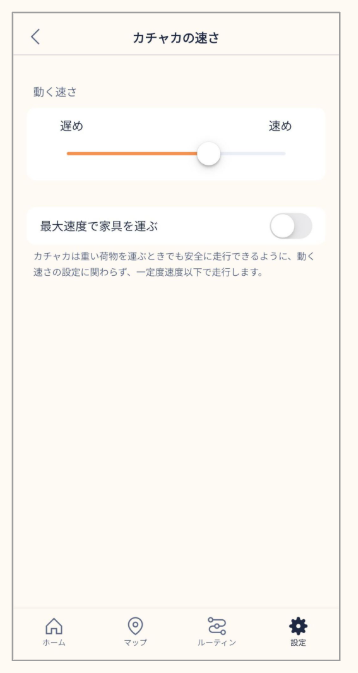
From robot software v3.4.7 onward, a “carry furniture at maximum speed” setting was added; enabling it lets Kachaka reach the 0.8m/s top speed even while carrying furniture.
The actual travel speed also changes with the movement speed setting — see Adjusting Movement Speed.
Taiwan NCC Certification
This product has obtained Taiwan NCC type approval:
- Kachaka (home, model B1T01): CCAM25LP1971T5
- Kachaka Pro (model B2T01): CCAM25LP1970T3
Low-power RF device notice:
Without prior approval from the NCC, no company, firm, or user is permitted to change the frequency, increase the transmission power, or alter the original design characteristics or functions of an approved low-power RF device. The use of low-power RF devices must not affect flight safety or interfere with lawful communications; if interference is found, the user must cease operation immediately and may resume use only after the interference has been eliminated. Low-power RF devices must accept interference from lawful communications or from radio-wave-emitting equipment used for industrial, scientific, and medical purposes.
Screens